This article also appeared in Finweek Magazine in their 13-June 2013 issue
Unconventional shoe retailer Zappos is getting a lot of attention for its business model and culture centred on the happiness of its workers. And they are reaping the rewards. In yearly workplace surveys from Fortune Magazine and the like. Zappos has been consistently rated as one of the top companies to work for. They have also excelled in the traditional business metrics. It took Zappos under 10 years to reach $1bn in annual revenue. They were acquired by Amazon in 2009 for a sizeable $1.2bn. There is a powerful lesson here. Like Zappos, by putting the happiness and well-being of your staff on centre stage, companies can build a happy culture that is healthy for profits and growth. Continue reading →
This article also appeared in Finweek Magazine in their 16-May-2013 issue
On the way to taking our 8-year-old son Jayden to karate, my husband told him that he had to leave a meeting early to come pick him up. So Jayden asked: “Are meetings fun? Are they like play-dates for adults?”
Jayden’s comment was spot-on. Meetings are a waste of time, and most of us would rather be working. In 37 Signals’ best-selling book Rework, the company reminded their staff that “every minute you avoid spending in a meeting is a minute you can get real work done instead.” Best of all, in 2011, 37 Signals even implemented National Boycott a Meeting Day.
However, if you absolutely must have a meeting, how can you make them more effective? Here are some useful tips. Continue reading →
This article also appeared in Finweek Magazine in their 09-May-2013 issue
Dave was in the market for a new car. One afternoon he happened to be driving past the Ferrari showroom when he thought: “Why don’t I take one for a test drive?” An hour later he returned from an exhilarating drive in a Ferrari 458 Spider, with the top down and the engine roaring like a caged panther. Dave was sold. He asked the manager: “So, how much will this one set me back?” The manager responded: “Tell me how much you want to pay….”
If you were like Dave, you probably would have also done a double take. Pay what you want for a brand-new Ferrari? Seriously?
As much as we wish it would, Pay What You Want (PWYW) has not penetrated the luxury sports car industry, at least not yet. But worldwide, more and more business people are experimenting with this controversial new business model across many industries: from restaurants, the music industry, to gaming and movies and free online services like Mozilla Firefox and Wikipedia. So far all of these industries centre around goods and services that don’t cost a lot. Could PWYW spread to industries with big ticket items like cars and property? More importantly, does the PWYW model work? And do the numbers make business sense?
This article also appeared in Finweek Magazine in their 02-May-2013 issue
A few years back my mother, a Professor and Head of Department at the Wits Faculty of Social Work, was forced to retire at age 65. Despite being very good at her job and showing no signs of mental or physical deterioration with age, she was stripped of her professorship and all that she could still do for the department, simply because she hit 65. In today’s day and age, is retirement at age 65 not an archaic concept that needs to be put to rest? Continue reading →
This article also appeared in Finweek Magazine in their 25-April-2013 issue
Overnight singing phenomenon Paul Potts stole the hearts of millions of people around the globe. The soft-spoken mobile phone salesman came from humble origins in Bristol, England, the son of a working-class bus-driver father and supermarket-cashier mother. From the age of six Potts had been bullied in school for being poor, which had eroded his self-confidence. A serious bicycle accident in 2003 and subsequent financial troubles motivated him to enter the debut series of Britain’s Got Talent. Despite not having sung in four years, when he started singing on that stage in 2007, he blew the judges and audience away with his surprisingly incredible voice. With his breath-taking performance of “Nessun dorma”, Potts went on to win Britain’s Got Talent and receive worldwide acclaim, with his debut album One Chance topping sales charts in nine countries.
There is something captivating about underdogs like Paul Potts. When we see the longshot win against the odds, it makes us believe that nothing is impossible and we really can achieve our biggest dreams. This is true both in our personal lives and the business world. There are many examples of small companies taking on the industry giants and winning: Apple vs. Microsoft and IBM, Virgin’s Richard Branson, Whole Foods’ John Mackey, Southwest Airlines’ Herb Kelleher and Fedex’s Fred Smith. Locally we’re seeing it in the cell phone industry with Cell C versus MTN and Vodacom.
Yes, it is possible for minor players to take on big companies and come out on top. How they do it? Here are some of the strategies that work: Continue reading →
This article also appeared in Finweek Magazine in their 11-April-2013 issue
Before World War 2, development capital was limited largely to wealthy individuals and families. It was only in 1946 that venture capital (VC) began to emerge. That year the first two VC companies, American Research and Development Corporation (ARDC) and JH Whitney & Company, were created in the US. Since then, entrepreneurs have pretty much depended on VCs to build high-growth businesses. But that could be changing. With the advent of crowd-funding and the dramatic drop in costs to launch an Internet start-up, do tech entrepreneurs still need VCs? Continue reading →
This article also appeared in Finweek Magazine in their 28-March 2013 issue
The 36 Chinese Stratagems are an essay of powerful tricks personifying the ancient Chinese art of being cunning. Not only are these stratagems potent tactics in times of war and politics, but they can also be effective in today’s business world.
First revealed in history roughly 1 500 years ago and written up almost 500 years ago, since the Nineties the stratagems have become increasingly popular in the Chinese world of business. However, they are still relatively unknown in Western countries.
One of the stratagems gives the following advice:
“Feign madness but keep your balance: Hide behind the mask of a fool, a drunk, or a madman to create confusion about your intentions and motivations. Lure your opponent into underestimating your ability until, overconfident, he drops his guard. Then you may attack.”
In laymen’s terms, if your adversary thinks you are crazy, he won’t feel threatened by you and so will not take you seriously or put up a fight against you. Continue reading →
This article also appeared in Finweek Magazine in their 21-March 2013 issue
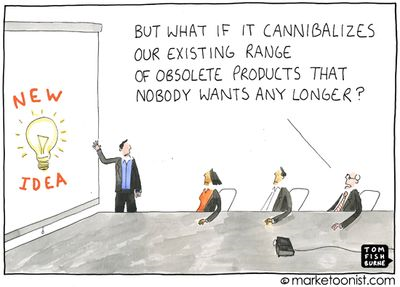
Prozac, a breakthrough treatment for depression, is one of the biggest-selling, most profitable medications of all time. Since its launch in 1988, Prozac accounted for US$ 21bn in sales and 34% of Eli Lilly’s revenues in that time. In essence Lilly was the house that Prozac built. However, the US patent for Prozac was coming up for expiry in 2001. Executives at Lilly knew that this would trigger such a huge loss of revenue that 2001 was known throughout the company as “Year X”. So how did Eli Lilly prepare for Year X? In South Africa in 1997, Eli Lilly introduced Lilly Fluoxetine, its own generic version of Prozac. But this would eat into sales of Prozac. Why would Eli Lilly conceivably do such a thing?
Inevitably, markets are cannibalised. As business leaders, we have a choice: we can either cannibalise our own business lines, or we can enable existing or new competitors to cannibalise it for us. With pricey Prozac coming off patent, it was inevitable that other pharmaceutical companies would jump in to claim their share of the very lucrative antidepressant market. Rather than let competitors grab its Prozac market share with generics, Lilly chose to bring out its own generic. The thinking was that Prozac users could be converted to the cheaper, chemically similar Lilly Fluoxetine, rather than to the competitor antidepressants, and this would prevent some of the Prozac fallout. It was a smart strategy and helped Lilly stay in the antidepressant game.
So why should you cannibalise your own business? And what can happen if you don’t? Continue reading →
This article also appeared in Finweek Magazine in their 4-April-2013 issue
Joe and I met at a networking event recently. Joe is new to the entrepreneurial game and wants to start a business in the restaurant industry. When I asked Joe to tell me more about his concept, he immediately clammed up. “I’d prefer not to discuss it until it is launched”, he said hesitantly. “However if you could sign a confidentiality agreement, I do have one with me …”
I meet entrepreneurs like Joe all the time. Like most entrepreneurial newbies, he is very protective of his idea. His greatest fear is that copycats will steal it. So he guards his baby zealously, and doesn’t even tell his friends about it. By contrast, mature entrepreneurs who have been in the game for a while are only too happy to tell others about their ideas. Here’s why: Continue reading →
This article also appeared in Finweek Magazine in their 07-March 2013 issue
In last week’s article we explored how growing too quickly could sometimes, but not always, be bad for your business. By contrast, even though it often gets a bad rap, slower, organic growth, could actually be a better strategy for your business in the long-run. Continue reading →










 www.colettesymanowitz.com