This article also appeared in Finweek Magazine in their 30-May-2013 issue
The 12th series of US singing competition American Idol reached its finale last week. 23-year-old vocal powerhouse Candice Glover took the title. With her talent you’d think she would have been a clear favourite. But this wasn’t always the case. In fact, this was Candice’s third attempt on the show. She had auditioned for the ninth and 11th seasons but didn`t reach the finals until the 12th season. In a previous season, former Idols judge Simon Cowell condescendingly told Candice she would never amount to more than a lounge singer. But he didn’t bank on her strong sense of determination. “I always knew for some reason that it would happen if I kept going,” said Glover backstage after her 2013 win. There is a powerful lesson that many entrepreneurs can learn from Candice Glover: Persistence pays off. Continue reading →
At a recent computer expo (COMDEX), Bill Gates reportedly compared the computer industry with the auto industry and stated:
“If Ford had kept up with technology like the computer industry has, we would all be driving $25 cars that got 1,000 miles to the gallon.”
In response to Bill’s comments, Ford issued a press release stating:
If Ford had developed technology like Microsoft, we would all be driving cars with the following characteristics:
1. For no reason whatsoever, your car would crash…twice a day.
2. Every time they repainted the lines in the road, you would have to buy a new car.
3. Occasionally your car would die on the freeway for no reason. You would have to pull to the side of the road, close all of the windows, shut off the car, restart it, and reopen the windows before you could continue. For some reason you would simply accept this.
4. Occasionally, executing a maneuver such as a left turn, would cause your car to shut down and refuse to restart, in which case you would have to reinstall the engine.
5. Macintosh would make a car that was powered by the sun, was reliable, five times as fast and twice as easy to drive – but would run on only five percent of the roads.
6. The oil, water temperature, and alternator warning lights would all be replaced by a single “This Car Has Performed An Illegal Operation” warning light.
7. The airbag system would ask: “Are you sure?” before deploying.
8. Occasionally, for no reason whatsoever, your car would lock you out and refuse to let you in until you simultaneously lifted the door handle, turned the key and grabbed hold of the radio antenna.
9. Every time a new car was introduced car buyers would have to learn how to drive all over again because none of the controls would operate in the same manner as the old car.
10. You’d have to press the “Start” button to turn the engine off.
PS – Oh and here is another one that is doing the rounds:
When all else fails, you could call “customer service” in some foreign country and be instructed in some foreign language how to fix your car yourself!
This article also appeared in Finweek Magazine in their 16-May-2013 issue
On the way to taking our 8-year-old son Jayden to karate, my husband told him that he had to leave a meeting early to come pick him up. So Jayden asked: “Are meetings fun? Are they like play-dates for adults?”
Jayden’s comment was spot-on. Meetings are a waste of time, and most of us would rather be working. In 37 Signals’ best-selling book Rework, the company reminded their staff that “every minute you avoid spending in a meeting is a minute you can get real work done instead.” Best of all, in 2011, 37 Signals even implemented National Boycott a Meeting Day.
However, if you absolutely must have a meeting, how can you make them more effective? Here are some useful tips. Continue reading →
This article also appeared in Finweek Magazine in their 25-April-2013 issue
Overnight singing phenomenon Paul Potts stole the hearts of millions of people around the globe. The soft-spoken mobile phone salesman came from humble origins in Bristol, England, the son of a working-class bus-driver father and supermarket-cashier mother. From the age of six Potts had been bullied in school for being poor, which had eroded his self-confidence. A serious bicycle accident in 2003 and subsequent financial troubles motivated him to enter the debut series of Britain’s Got Talent. Despite not having sung in four years, when he started singing on that stage in 2007, he blew the judges and audience away with his surprisingly incredible voice. With his breath-taking performance of “Nessun dorma”, Potts went on to win Britain’s Got Talent and receive worldwide acclaim, with his debut album One Chance topping sales charts in nine countries.
There is something captivating about underdogs like Paul Potts. When we see the longshot win against the odds, it makes us believe that nothing is impossible and we really can achieve our biggest dreams. This is true both in our personal lives and the business world. There are many examples of small companies taking on the industry giants and winning: Apple vs. Microsoft and IBM, Virgin’s Richard Branson, Whole Foods’ John Mackey, Southwest Airlines’ Herb Kelleher and Fedex’s Fred Smith. Locally we’re seeing it in the cell phone industry with Cell C versus MTN and Vodacom.
Yes, it is possible for minor players to take on big companies and come out on top. How they do it? Here are some of the strategies that work: Continue reading →
This article also appeared in Finweek Magazine in their 28-March 2013 issue
The 36 Chinese Stratagems are an essay of powerful tricks personifying the ancient Chinese art of being cunning. Not only are these stratagems potent tactics in times of war and politics, but they can also be effective in today’s business world.
First revealed in history roughly 1 500 years ago and written up almost 500 years ago, since the Nineties the stratagems have become increasingly popular in the Chinese world of business. However, they are still relatively unknown in Western countries.
One of the stratagems gives the following advice:
“Feign madness but keep your balance: Hide behind the mask of a fool, a drunk, or a madman to create confusion about your intentions and motivations. Lure your opponent into underestimating your ability until, overconfident, he drops his guard. Then you may attack.”
In laymen’s terms, if your adversary thinks you are crazy, he won’t feel threatened by you and so will not take you seriously or put up a fight against you. Continue reading →
This article also appeared in Finweek Magazine in their 21-March 2013 issue
Prozac, a breakthrough treatment for depression, is one of the biggest-selling, most profitable medications of all time. Since its launch in 1988, Prozac accounted for US$ 21bn in sales and 34% of Eli Lilly’s revenues in that time. In essence Lilly was the house that Prozac built. However, the US patent for Prozac was coming up for expiry in 2001. Executives at Lilly knew that this would trigger such a huge loss of revenue that 2001 was known throughout the company as “Year X”. So how did Eli Lilly prepare for Year X? In South Africa in 1997, Eli Lilly introduced Lilly Fluoxetine, its own generic version of Prozac. But this would eat into sales of Prozac. Why would Eli Lilly conceivably do such a thing?
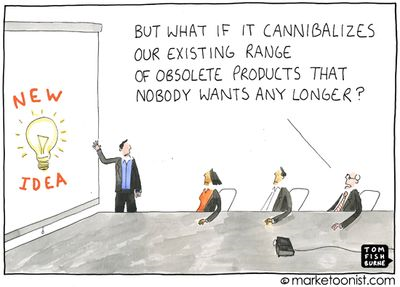
Inevitably, markets are cannibalised. As business leaders, we have a choice: we can either cannibalise our own business lines, or we can enable existing or new competitors to cannibalise it for us. With pricey Prozac coming off patent, it was inevitable that other pharmaceutical companies would jump in to claim their share of the very lucrative antidepressant market. Rather than let competitors grab its Prozac market share with generics, Lilly chose to bring out its own generic. The thinking was that Prozac users could be converted to the cheaper, chemically similar Lilly Fluoxetine, rather than to the competitor antidepressants, and this would prevent some of the Prozac fallout. It was a smart strategy and helped Lilly stay in the antidepressant game.
So why should you cannibalise your own business? And what can happen if you don’t? Continue reading →
This article also appeared in Finweek Magazine in their 28-Feb-2013 issue
In 1999, the Webvan Group promised to transform the grocery shopping industry. Thanks to an über-successful IPO and other sources such as venture capitalists, it raised a staggering $1.2bn in start-up capital, rivalling big players like Amazon.com. Fast forward to 2001, when Webvan went bankrupt, barely 18 months later. The cause? It ran out of money.
How is this possible?
When investors inject capital into a business, they want a return on their money. And the expectation is that rapid growth will usually fuel this return. Americans even have an expression for fast-growing firms: “gazelles” are publicly traded companies that have grown at least 20% for each of the previous four years, kicking off with US$ 1m or more in sales.
But sometimes, growing too quickly can actually be bad for business. Continue reading →
This article also appeared in Finweek Magazine in their 7-Feb-2013 issue
Four years out of our MBA degrees, my MBA classmate Joanne* was working in a senior position at a leading global FMCG company. She was extremely well-paid, got to travel extensively and had all the usual corporate perks. Everyone thought she had the perfect set-up. But inside, Joanne was desperately unhappy. Her dream was to start her own business, and she would spend all her spare time researching an idea she was passionate about. However, she had two children whose private education didn’t come cheap, a sizeable homeloan to pay off, and her husband’s investment business had taken a knock in the global financial crisis. So the family depended on Joanne’s salary. As much as she wanted to quit her job in corporate, she didn’t think she could. Sensing her unhappiness, Joanne and I met for lunch to explore if there was a way she could successfully make the leap from corporate to a start-up. Some valuable lessons came out of our discussion that hopefully can help others in the same predicament.
I made the transition in 2007 and it was the best career decision I have ever taken. The entrepreneurial environment, however, isn’t for everyone. And corporate will be extremely tempting when you hit the inevitable rocky period in your venture. Before making the leap from corporate to start-up, you need to understand what you’re getting into and if you’re cut out for it.
So the first question to address is: What traits do you need to have in order to succeed in a start-up? Continue reading →
This article also appeared in Finweek Magazine in their 24-Jan-2013 issue
The more resources you invest in a business or project, the harder it is to walk away. But sometimes quitting may be the best thing you can do. Continue reading →
This article also appeared in Finweek Magazine in their 17-Jan-2013 issue
In recent years MBA programmes have received a lot of criticism: teaching flawed financial thinking, ignoring business ethics, hiding from the real world of business and sheltering MBA students in academic theory. And so, as the argument goes, MBA business leaders are ruled by greed and short-term gain. Hence much of the blame for the global financial crisis fell on high-profile MBA alumni like Lehman Brothers’ Richard Fuld (Stern’s MBA of 1973), and Merrill Lynch’s John Thain (Harvard 1979). Let’s not forget Jeff Skilling of Enron, who had an MBA, while Bill Gates and Steve Jobs didn’t even complete university.
With these criticisms in mind, do MBA-degreed CEOs perform better than their non-MBA peers? The effect of a CEO’s MBA (or lack of one) on the business’ performance is very much contested ground, with evidence to support both sides. Continue reading →

 This article also appeared in Finweek Magazine in their 30-May-2013 issue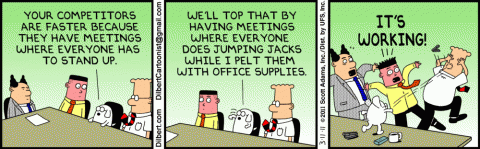





 This article also appeared in
  www.colettesymanowitz.com